
2.2YOU’VE COMPLETED 0 STEPS IN WEEK 2
Staying connected
In this step, you will start by focusing on the problem of how to help learners stay connected to their training across several locations.
Apprentices typically spend 80% of their time (that’s four days a week) in the workplace, and 20% of their time (one day a week) fulfilling the requirement for off-the-job training. This requirement is prescribed under the ESFA (Education and Skills Funding Agency) rules for apprenticeships.
The off-the-job training can take a number of forms:
- Day release at college.
- Day release at a training provider.
- Training provided by the employer.
- It can also take place in small chunks throughout the week, rather than on one specific day.
This training can also be:
- face-to-face
- online
- blended.
The use of a blended learning approach is encouraged. However, it is not permitted for all off-the-job training to consist of distance learning.
The Department for Education provides an example of using a blended approach:
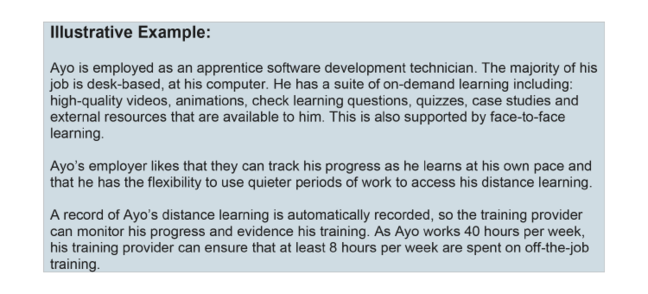
DfE, Apprenticeships off-the-job training. June 2017, p.9.
Where do apprentices work?
For most apprentices there are at least four different locations involved in their apprenticeship:
- college/training provider
- workplace
- commute
- home/library.
Who do apprentices work with?
An apprentice works with and builds up relationships with a number of people throughout the apprenticeship. This includes:
- trainers/coaches at college or through their training provider
- their manager at their workplace
- other apprentices at the same college/training provider
- other apprentices at the same workplace.
Having contact with everyone involved in their apprenticeship anytime, anywhere allows apprentices to join up their experience and to understand how their off-the-job training links to the workplace training.
Have your say:
Describe the context for your apprentices:
- How is the 20% off-the-job training organised?
- How many different locations do your apprentices work in and with how many different groups of people?
- What are some of the challenges this brings for you and for your apprentices?
Share and discuss your thoughts with other learners in the Comments.
© University of Leeds / UCL / Ufi Charitable TrustView 1 commentMark as completeKEEPING CONNECTED: MODELLING GOOD PRACTICEVIDEOWELCOME TO WEEK TWOVIDEO
DOWNLOADS
- OFF-THE-JOB TRAINING GUIDANCE FROM THE UK GOVERNMENT PDF
- ESFA FUNDING AND PERFORMANCE MANAGEMENT RULES FOR APPRENTICESHIPS PDF
 BLENDED LEARNING 2